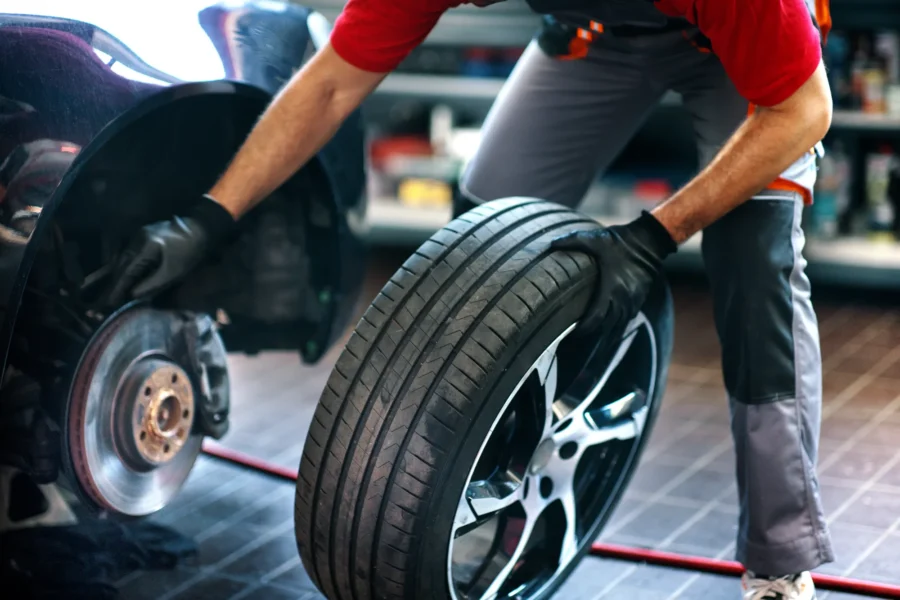
You pick the car up at the Flowood store, the tires look great, and the invoice says the job is done. Then a technician says something that sounds like an upsell: bring it back in a few days so we can recheck the lug nuts. It isn’t an upsell. It’s the last step of the job, and it’s the only step that can’t be finished in the bay on the day the wheels go on.
Here’s why. A wheel isn’t held on by lug nuts the way most drivers picture it. The nuts and studs form a clamp, and that clamp has to settle before anyone can confirm it landed where it belongs. The settling happens out on Lakeland Drive, on the run down I-55 into Jackson, on the Reservoir loop, not on the lift. A wheel torque check in Flowood MS takes a few minutes, and it’s the difference between a wheel that’s torqued and a wheel that’s just zipped on.
What Actually Holds Your Wheel On
Picture the back of your wheel pressed flat against the hub face. Tightening the lug nuts stretches the studs very slightly, and that stretch pulls wheel and hub together with enormous force. That force is called clamping load, and the friction it creates between those two flat surfaces is what carries your vehicle down the road.
The studs aren’t pins holding the wheel in place like nails in a board. They’re the springs that generate the squeeze. Torque is how a shop measures that squeeze from the outside, since nobody can see clamping load directly. Turn the nut to a specified value with a calibrated wrench and you get a predictable clamp.
That distinction explains everything else here. Get the clamp right and wheel and hub behave as one piece. Let it drift low and the two surfaces start moving against each other in tiny increments, wearing the hardware out. Drive it too high and the studs stretch past where they were meant to go, distorting the parts they bolt through.
Why the Impact Gun Is Not the Last Step of a Tire Installation in Flowood MS
Walk past any tire bay in Rankin County and you’ll hear the impact gun. It’s a fast, useful tool and it belongs in the job. What it isn’t is a measuring tool. A gun runs a nut down quickly, but the torque it actually delivers depends on air pressure, thread condition, and how the joint behaves that particular minute.
So a torque wrench finishes what the gun starts. According to Bauer Built, consumer tools like the tire iron in your trunk give no precise reading at all, while shops use calibrated torque wrenches alongside their pneumatic and electric tools to hit the specified value. The gun seats the nut. The wrench sets the number.
Sequence matters as much as the number. Continental describes the proper procedure as a torque wrench set to half torque first, then brought to full torque in a crisscross pattern. Going around the wheel in a star rather than a circle pulls it down square against the hub, so every stud carries a fair share of the load instead of two of them doing most of the work.
Alcoa makes the same point from the fleet side, warning that one-inch impact guns risk over-torquing and stating plainly that over-torquing is just as damaging as under-torquing. Those specs are written for heavy-duty aluminum truck wheels, not the family sedan, but the principle carries across every vehicle in the lot.
Why Torque Walks Off in the First Few Miles
This is the part that surprises people. The clamp can be correct when the vehicle leaves the shop and read lower a hundred miles later, with nobody having done a thing wrong.
Continental lists the culprits: vibration and load cycles, cycles of warming and cooling, nudges from bumps. It names a subtler one too, contamination. Dirt, sand, rust or grit trapped between the mating surfaces can create what it calls a false torque, where force applied at the wrench doesn’t fully translate into clamping force. The wrench reads correct. The clamp underneath isn’t.
Bauer Built adds vehicle weight and wheel rotation straining the fasteners, temperature swings, road hazards such as potholes, and dirt or rust on the thread surfaces. Every one of those describes a normal week of driving between Flowood, Pearl and Brandon. Pothole season alone covers the road-hazard cause, which is why a recheck isn’t just a new-tire thing.
The settling, then, is expected, and the industry answer is a follow-up. Bauer Built recommends having lug nuts retorqued after driving 50 to 100 miles following a tire rotation or replacement. Commercial Tire gives the same initial window of 50 to 100 miles, then every 5,000 miles and at any scheduled tire rotation, because the dynamics of driving cause the nuts to settle and lose torque. Continental, writing in metric for European drivers, advises garages and tire dealers retorque wheels roughly 50 km after a tire change. Alcoa calls for an initial torque check within 5 to 100 miles on heavy-duty wheels.
Different sources, different units, same idea: the check belongs early. A lug nut retorque after tire installation is standard practice, not an admission that something went wrong. For most Flowood drivers those first 50 to 100 miles amount to a few days of commuting, which is why we ask you back that soon.
Too Loose: What Under-Tightening Does
A clamp that has drifted low doesn’t fail all at once. It fails in stages, and each stage brings the next one on faster.
- The wheel starts moving a fraction against the hub instead of riding as one piece with it.
- That movement works the bolt holes, and the seats where the nuts sit start to wear and elongate.
- Continental notes that under-torqued wheels loosen gradually, especially on rough roads, with wobble and vibration following.
- The studs take repeated flexing they were never designed for and fatigue.
- Wear accelerates on studs and hub together, so a small problem becomes a hardware problem.
- At the end of that sequence sits the outcome nobody wants. Continental and Bauer Built both name it directly: the wheel can come off during operation.
A recheck is worth the appointment because the whole chain is preventable at stage one, and stage one makes no noise.
Too Tight: What Over-Tightening Does
The opposite mistake costs just as much, and it happens more than drivers assume, because “extra tight” feels like extra safe.
Bauer Built notes that over-tightening can strip the fastener thread and stretch wheel studs. Continental lists the same, plus warped brake drums, rotors or hubs, and studs weakened or broken over time.
Sit with that rotor point for a second. A brake pulsation showing up a week or two after new pads gets blamed on bad rotors almost every time, yet distortion sits right there on Continental’s list of over-torquing consequences. If your pedal started pulsing shortly after a wheel came off, rule the fastening out before anything gets replaced. It’s a close cousin of the noises we cover in 10 Reasons for Thumping Noises When Braking.
The nastier detail: a stretched stud looks completely normal. Steel pulled past its intended limit doesn’t spring back the way it should, so it can’t generate a proper clamp anymore even with the nut set to the correct value. Nothing on the outside gives it away. A shop that torques by measurement rather than by feel is protecting hardware you never see.
What a Wheel Torque Check in Flowood MS Actually Involves
The visit is short, and nothing like a repair appointment.
The vehicle goes up. Working one wheel at a time, the technician loosens each nut slightly and resets it to the manufacturer’s specification with a calibrated torque wrench, following the crisscross sequence so the wheel seats square. Backing the nut off first matters, because a nut already sitting at some unknown value can’t be measured accurately by leaning on it harder.
While the wheel is accessible, the technician reads the things that tell a story. Rust streaking out from a lug seat suggests movement, and shiny arcs or polished witness marks around the seats say the same. Studs get checked for thread damage and for nuts that won’t run down cleanly. Hub and wheel mating surfaces get looked over for rust or debris, the contamination behind the false torque Continental describes.
Then you hear what turned up. Usually everything came back within specification, which is a real result and not a wasted trip. Sometimes a nut had settled, which is the whole reason the check exists. Once in a while hardware needs replacing, and you’ll hear about that first. If a repair is recommended, ask the Flowood store for a current quote rather than working off a number you read somewhere, since parts and labor pricing moves and a stale figure helps nobody.
Symptoms That Mean Come Back Now, Not Next Week
Don’t wait for the scheduled recheck if you notice any of these in the days after a wheel has been off your vehicle:
- A clicking or ticking from one corner at parking-lot speed, often loudest during slow turns.
- A rhythmic wobble or shudder that appears above roughly 45 to 50 mph and worsens with speed.
- A new shimmy in the steering wheel, or a pulsing brake pedal that wasn’t there before the work.
- Rust streaks, shiny arcs or any visible movement around the lug seats.
- A lug nut sitting noticeably proud of its neighbors.
The classic case goes like this. A Flowood commuter picks up new tires, runs the Lakeland Drive and I-55 loop into Jackson for a few days, and on day three hears a faint tick from the right front while pulling into a parking space. That’s a settled clamp announcing itself, and catching it there is the entire point of the follow-up.
Which Jobs Earn a Lug Nut Retorque After Tire Installation or Service
Any job that takes a wheel off qualifies, not just new rubber:
- Tire installation in Flowood MS, a full set or a single replacement
- Tire rotations, the service behind why you need regular tire rotations
- Flat repairs
- Brake work, since the wheels come off to reach the pads and rotors
- Seasonal or aftermarket wheel swaps
- Lift kit installs and new wheel fitments, where fresh hardware beds in the most
- Any roadside spare change you handled yourself
That last one deserves its own line. A driver who changes a flat on the shoulder of MS 25 with the trunk wrench has torqued nothing by measurement, only by arm strength. That wheel needs a torque check more than a shop-installed one, not less.
Work trucks are their own category. A truck running Rankin County job sites loads and unloads all week, and load cycles plus heat cycles are two of the exact clamp-settlers Continental names. Fleet vehicles earn their rechecks faster than commuter cars do, and building the check into a service rhythm beats trying to remember it truck by truck. It’s the same logic behind the service rhythm we lay out for fleet operators in Columbus, GA, applied to a single line item.
No State Inspection in Mississippi Means the Shop Is the Backstop
Mississippi eliminated its annual vehicle safety inspection sticker effective July 1, 2015. That yearly check had covered turn signals, the horn and tires, and confirmed the vehicle was street legal. Aftermarket window tint remains the exception.
Whatever you make of that decision, it has one practical consequence here. Nobody looks at your vehicle once a year on the state’s behalf anymore. Flowood sits in Rankin County northeast of Jackson, and the miles our customers put on between here, Pearl, Brandon and Richland are ordinary commuter miles, so nothing prompts a driver to have the wheels looked at. The shop-side follow-up check fills that gap, and it costs you a short appointment instead of a repair.
Book Your Wheel Torque Check in Flowood
A wheel torque check is the cheapest insurance in the tire business, and at Gipson’s Tire & Auto it’s simply how a wheel-off job gets finished. Proven and trusted since 1979, we’d rather see you for five minutes now than for a stud replacement later. If you’ve had tires, brakes or a rotation done recently anywhere in the Jackson metro, or you changed a flat yourself on the side of the road, bring it by our Flowood store and let a technician set every nut to specification with a calibrated wrench.
Wondering what any related work would run? Ask us for a current quote rather than trusting a number from a blog post, and you’ll get pricing that reflects today’s parts and labor.
Ready when you are. Schedule an appointment at your Flowood store and we’ll get those wheels checked properly.