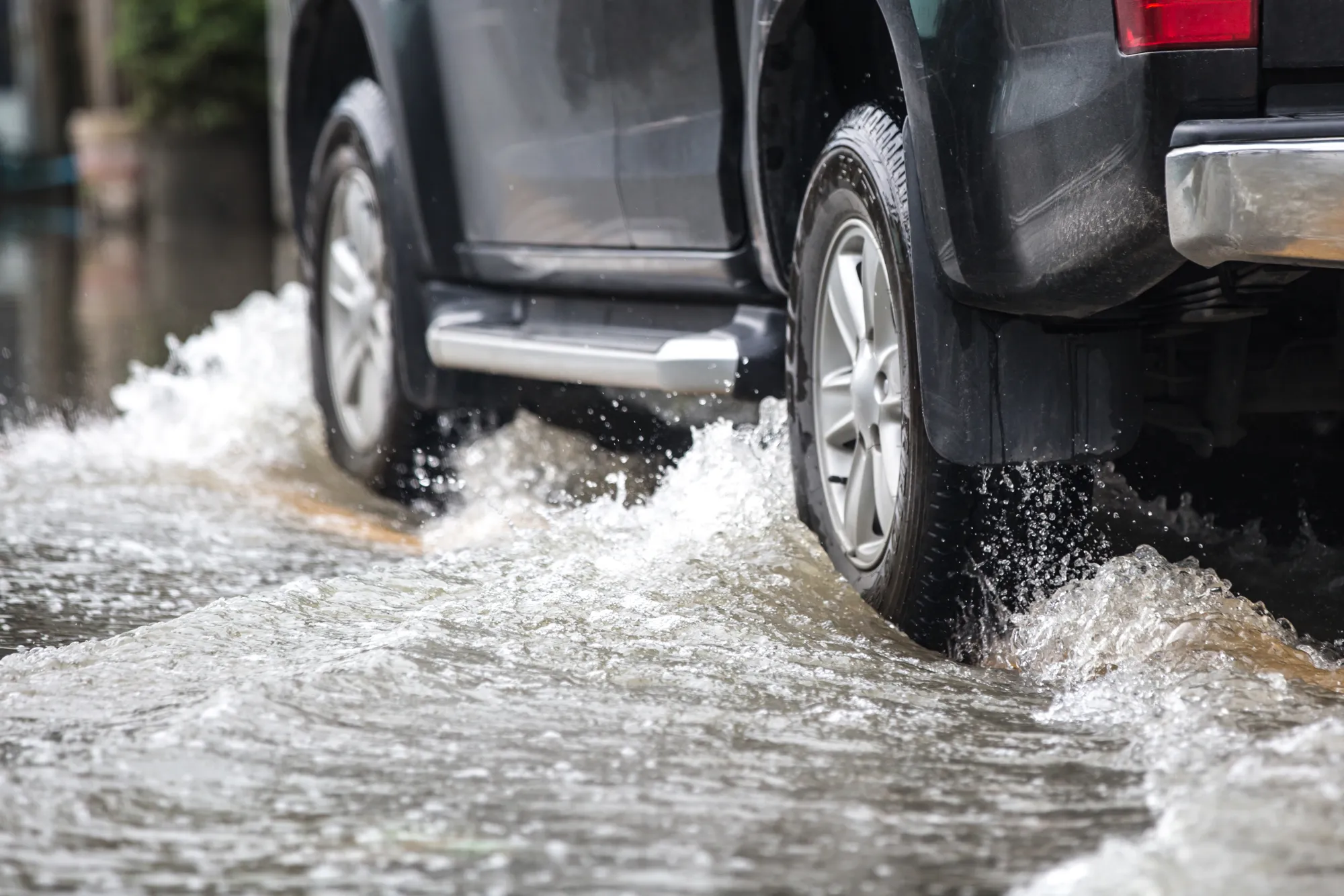
You know the moment. You’re heading west on I-10 out of Mobile, an August thunderstorm parks itself over the bay, and the outside lane turns into a sheet of standing water. The truck ahead throws up a wall of spray. For a second or two the steering goes light, the engine note lifts, and the car isn’t going where you’re pointing it.
That’s hydroplaning, and it isn’t bad luck. It’s a plumbing problem, and the only plumbing your car has for it is the grooves in your tires.
This post is about one number: how much tire tread depth you need to keep water moving out from under your tires at highway speed. It isn’t about how old your tires are. Age has its own warning signs, covered in Signs of Aging Tires. A tire can be young and still be a bad tire in the rain, and tread depth is the measurement that tells you which one you have.
What Hydroplaning Actually Is: Water Has to Go Somewhere
Each of your tires touches the road on a patch of rubber about the size of your hand. Everything your car does, the steering, the braking, the accelerating, happens through four hand-sized contact patches.
Now put a layer of water on the pavement. Water doesn’t compress. When your tire rolls onto it at speed, that water can’t be squeezed thinner, so it has to go somewhere in the fraction of a second before the tire arrives. There are only two exits: out to the sides, and up through the grooves in the tread.
That’s what the tread pattern is for. The grooves are drainage channels, scooping water out of the contact patch and throwing it behind the tire so the rubber lands on wet pavement instead of on a film of water.
When the grooves can’t move water fast enough, the water wins. Pressure builds ahead of the tire, the leading edge lifts, and the contact patch rides up onto a wedge of water. That’s the light steering you feel. Nothing you do with the wheel or the brake pedal reaches the road, because the tire is no longer touching it.
Two things decide whether the grooves keep up: how much water there is, and how deep they are. On the Gulf Coast you don’t control the first. You completely control the second.
Why Mobile Punishes Worn Tires More Than the Rest of Alabama
According to NOAA’s National Centers for Environmental Information data for 1991 through 2020, Mobile averages 67.1 inches of precipitation a year, spread across 117 days with precipitation. Montgomery averages 51.2 inches and Decatur 49.5. Cross the bay into Baldwin County and it gets wetter still: Fairhope 69.3 inches, Bay Minette 71.8. August is the peak at around 7.8 inches on its own, so the worst wet-road driving of the year lands in the same weeks as the worst heat.
A set of tires on a Prattville commuter and an identical set on a Mobile commuter wear at about the same rate, but the Mobile set has to clear standing water on something like 117 days a year. Tread depth that’s merely adequate inland is a gamble down here.
The roads compound it. Busy lanes on I-10 develop shallow ruts in the wheel tracks that hold water long after the crown of the road has drained. The Bayway is wide open to wind-driven rain with nowhere for a stalled car to go. Airport Boulevard and the Bel Air Boulevard area pond up at the low spots after a hard cell. Those are the places where a tire at the legal minimum stops being legal-and-fine and starts being legal-and-scary.
Legal Minimum vs Safe Minimum: 2/32 and 4/32 Are Not the Same Number
There are two numbers here, and only one of them is about safety.
The legal number: 2/32 inch
Alabama Code Section 32-5-210 makes it unlawful to operate a licensed vehicle on state highways when a tire has a tread depth of less than 2/32 inch. The law even specifies how to measure it: in any two adjacent tread grooves, at three equally spaced intervals around the circumference of the tire, and not at the tread wear indicators. The same section makes it unlawful to sell tires below that depth for highway use here. AAA notes that 42 states set the same 2/32 inch minimum.
Read that carefully. 2/32 inch is the point at which the tire is legally worn out. It’s a floor, not a target. It’s the state telling you the tire is finished, not that it’s fine.
The safe number: 4/32 inch
AAA and Consumer Reports both draw the wet-weather line at 4/32 inch, and the testing behind that recommendation is worth knowing. AAA compared new all-season tires against the same tires worn down to 4/32 inch on wet pavement:
- Tires at 4/32 inch needed 87 additional feet on average to stop a passenger car, and 86 for a light truck.
- Braked side by side from 60 mph, the car on worn tires was still traveling at 40 mph where the car on new tires had already stopped.
- Handling ability dropped by 33 percent for the passenger car and 28 percent for the light truck.
Sit with that middle one. Not “stopped a little later.” Still doing 40 mph. On I-10 in an afternoon storm, that’s the difference between a hard stop and a serious wreck, and it happens at 4/32 inch, twice the legal limit.
The reason is drainage math. New passenger tires typically start with about 10/32 to 11/32 inch of tread, so a tire at 4/32 inch has given up roughly two thirds of its water-clearing depth, and water evacuation drops off sharply right around that point. As AAA puts it, the lower the tire tread depth, the higher the chances of hydroplaning.
So a tire at 3/32 inch is perfectly legal in Alabama and well past the depth at which the people who test this for a living say to start shopping.
How to Read Your Own Tire Tread Depth in Under a Minute
You don’t need a shop or a special tool for a first answer. Pocket change and a parking spot will do.
The quarter test (the 4/32 inch check). Put a quarter into a tread groove with Washington’s head upside down and facing you. If you can see the top of his head, you have 4/32 inch of tread or less. On the Gulf Coast that’s your cue to start planning tire replacement in Mobile AL, not to wait and see.
The penny test (the 2/32 inch check). Same idea with a penny, Lincoln’s head upside down. If you can see the top of his head, you’re at 2/32 inch. That tire is worn out, at the legal limit, and needs replacing now.
The tread wear bars. Look into the grooves for the small raised rubber bridges across the tread. When those bars sit flush with the tread blocks, the tire is at 2/32 inch. A cheap tread depth gauge from any parts counter gives you the exact number instead of a yes or no.
Wherever you measure, measure in more than one place. Check several grooves, including the inside and outside shoulders, at three or four points around the circumference. That isn’t us being fussy, it’s essentially the method the Alabama statute describes.
Tires almost never wear evenly. A common one we see is a front-wheel-drive commuter with rears at 7/32 inch and fronts at 3/32 inch, because it has never been rotated. The tires doing the steering and most of the braking, the ones you need most in a downpour, are the ones that can no longer clear water. A glance at the back tires would say everything is fine. It isn’t.
Speed, Water Depth, and Why Highway Rain Is a Different Problem
Tread depth isn’t a pass or fail grade. It’s a rate. The grooves move a certain amount of water per second, and whether that’s enough depends on how much water is arriving and how fast you’re asking it to leave.
Roll through a damp street at 35 mph and even a worn tire has time to clear the contact patch. Take that same tire onto I-10 at 65 in a hard rain and two things change at once: far more water on the pavement, and far less time to move it. The tread depth that felt fine crossing Airport Boulevard is the tread depth that lets go on the interstate.
The honest advice for a Gulf Coast downpour is boring, and it works:
- Slow down before you think you need to. Lower speed gives the grooves more time per revolution, and it’s the most effective thing you can do with the tires you already own.
- Turn off cruise control in the rain. If a tire starts to float, it can add throttle at the worst possible moment.
- Stay out of the wheel tracks. The ruts worn into a busy lane hold the deepest water.
- Double your following distance. Remember the AAA number: worn tires needed 87 extra feet on a passenger car. You want that space to already exist.
- If the steering goes light, don’t brake hard or jerk the wheel. Ease off the throttle, hold the wheel steady, and let the car slow until the tires bite again.
Hydroplaning is about a thin film of water on a road you can still see. Standing floodwater is a different hazard entirely, and no tread depth solves it. The National Weather Service is blunt: 6 inches of fast-moving water can knock over an adult, 12 inches can carry away most cars, and 2 feet can carry away SUVs and trucks. On a flooded street, the answer isn’t better tires. The answer is turn around.
What a Wet-Weather Tire Inspection Looks At
Bring a vehicle into our Bel Air Boulevard store in Mobile before a rainy stretch and here’s what gets checked:
- Depth in several spots per tire. Multiple grooves and both shoulders, so a worn inside edge can’t hide from a quick look.
- Wear pattern. Shoulder wear, feathering, or a cupped surface usually means alignment or suspension, not a bad tire. Replace the tire without fixing the cause and the new one wears the same way.
- Match across the axle. Two tires on one axle with very different depths behave differently in water, and that’s what makes a car step sideways under braking.
- Inflation pressure. An underinflated tire changes the shape of the contact patch and can let the center of the tread lift away from the road, exactly the wrong thing in standing water.
- Damage unrelated to wear. Cuts, bulges, sidewall scuffs, embedded debris, slow leaks from an old road hazard.
Tread and wear pattern are the two that most often turn up something the driver didn’t know about. A tire that measures fine on the outside and is bald on the inside edge is an alignment story, and it ends with a hydroplane if nobody reads it.
When to Replace, and What to Ask the Shop
Make the call on remaining tread and how you actually drive, not on the calendar.
Replace at 4/32 inch if you commute at highway speed, if you regularly run I-10 or the Bayway, or if you carry passengers and cargo in a vehicle that’s heavy to stop. Don’t stretch to 2/32 inch. That last stretch is where the water clearing has already collapsed.
Replace in pairs at minimum, across the same axle, with the deeper tread on the rear so the back of the car stays planted. When you’re ready to compare options, you can shop for tires by size or vehicle.
Ask us three things: your measured depths on all four corners, whether the wear pattern points at anything mechanical, and what a good wet-traction tire looks like for your vehicle. For what any of it costs, ask us for a current quote. Tire and service pricing moves too fast for a blog post to give you a number that’s still true when you read it, and a stale number is worse than none.
Get Your Tread Checked Before the Next Storm Line
Mobile gets rain on more than a hundred days a year, and I-10 doesn’t care what your tires looked like last spring. If you can’t remember the last time anyone measured your tire tread depth, that’s the whole job, and it takes a few minutes.
Stop by our Bel Air Boulevard store in Mobile and we’ll measure all four tires, read the wear pattern, check your pressures, and tell you honestly whether you’re good for another season or one downpour away from finding out the hard way. If you’re searching for tire replacement in Mobile AL and you already know it’s time, request a quote and we’ll get you the right tire for Gulf Coast rain at a current price.